Prime lenses have one focal length and no zoom. That sounds limiting, but it’s why they’re sharp and bright. This guide helps you pick the right one for your Pentax body and the photos you want to take.
Table of Contents
Verdict
Most Pentax prime buyers are choosing between a portrait lens and an everyday lens. These picks split on focal length and aperture, which decide how close you stand and how much background blurs.
Best overall: Pentax HD D FA 85mm, for its telephoto portrait reach, its listed flare-free coating, and weather sealing that suits outdoor work.
Best for a first prime: Pentax SMC Pental DA 35mm, because its listed compact, lightweight build makes it easy to carry all day.
Best for the simplest setup: Pentax SMC 50mm f/2.0, since it’s a manual focus lens with a bright maximum aperture and a natural field of view.
This guide is for buyers who want one solid prime and need help choosing the focal length first.
How We Picked
Comparing the Amazon listings for prime lenses for Pentax cameras, we set out to find which ones are worth a look. To earn a place, a lens had to show clear facts in its listing, such as focal length, maximum aperture, mount type, and what’s included. Those facts let us line up one lens against another on the same terms. Listings that named a focal length but left out the aperture, or that described a lens in glowing terms without any specifics, gave us nothing firm to compare, so we set them aside rather than guess at their strengths.
We dropped listings with too little detail to compare. A lens with a stated focal length and a vague “high quality” line can’t be weighed against a lens that lists its focusing distance, weight and mount. That doesn’t mean the dropped lenses are bad, only that a buyer couldn’t check their claims from the page alone, and we didn’t want to recommend something we couldn’t verify.
The five picks below are the ones whose listings gave us enough to judge them side by side. Each one states its focal length, its maximum aperture, and its mount, and most also list its autofocus system, its coatings, or its minimum focusing distance. Those details are what let us compare a fast 85mm portrait lens with a compact 35mm standard lens on the same footing.
Comparison Table
All 5 products side by side — scroll sideways to see every column.
| Top Pick | Best for Low Light | Best for Street Travel | Best for Beginners | Best for Manual Focus | |
| Preview | 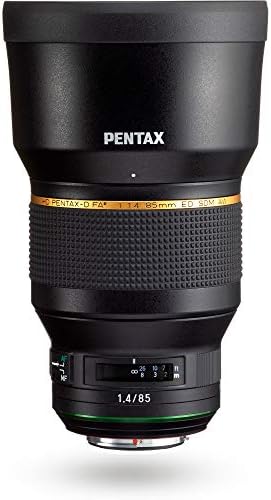 |  |  |  |  |
|---|---|---|---|---|---|
| Product | Pentax HD D FA 85mm | Sigma 85mm f/1.4 EX DG | Pentax 31mm FA Limited | Pentax SMC Pental DA 35mm | Pentax SMC 50mm f/2.0 |
| Brand | Pentax | Sigma | Pentax | Pentax | Pentax |
| Best for | Top Pick | Best for Low Light | Best for Street Travel | Best for Beginners | Best for Manual Focus |
| The listing says | In-body shake reduction works with any K-series lens Star-series lens with high resolving power | Built for full frame; works on APS-C too HSM gives quiet, fast autofocus | Limited lens with very high image quality Wide-angle perspective | In-body shake reduction works with any K-series lens Ideal first lens for background blur and sharp edges | Crisp images with detail and vibrant colors Natural 50mm perspective for portraits and street |
| More information | Check Price on Amazon | Check Price on Amazon | Check Price on Amazon | Check Price on Amazon | Check Price on Amazon |
The Picks
Every pick here is a prime, meaning one fixed focal length with no zoom. That’s the reason for the lineup’s focus: each lens does one job well. Before you buy, check which lens mount your body takes, since the Pentax HD D FA 85mm uses the KAF4 mount, and its listing names the compatible cameras.
Think about the shooting you do most. If you mostly photograph people at a distance, the 85mm and 135mm lenses compress the background and keep you back from your subject. If you want to fit a room or a landscape into the frame, the 21mm and 28mm wide-angle lenses do that, and the 31mm sits between them as a general-purpose wide lens.
The 85mm options differ mainly in how they handle the autofocus motor. The Pentax HD D FA has a ring-type ultrasonic motor, while the Sigma uses a Hyper-Sonic Motor for quiet, fast focusing, and the Sigma also allows manual focus at any time. If you plan to focus by hand most of the time, a manual-focus lens such as the 135mm Takumar may suit you better, though it asks for more practice.
A useful detail on the Pentax 35mm is its close focus of 0.3 meters, which is about 0.98 feet, so it can get close enough for small subjects. Lenses with a shorter minimum focus distance let you fill the frame with a subject that sits near you, which matters more to some shooters than the lens’s maximum aperture.
1. Pentax HD PENTAX-D FA★85mmF1.4ED SDM Prime Telephoto Lens New-Generation
Best for: Portrait shooters who want a longer telephoto look.
This is a telephoto prime with a fast F1.4 aperture. Its listing says it uses three super ED glass elements and aspherical elements to reduce color fringing, and that it has an HD coating for high contrast without flare.
Its listed autofocus motor is the SDM type, and the listing says it’s faster than the motor in the 50mm F1.4 SDM AW. The round nine-blade diaphragm is listed to give smooth background blur up to F2.8. Stopping down past F2.8 still works, but the listing only promises this blur quality up to that point, so it’s worth keeping the lens at F2.8 or wider when you want the softest backgrounds.
The listing describes a fluorine-treated front coating meant to stop dust, water drops and grease sticking.
In daily use, 85mm means you stand farther from your subject than with a 50mm, so it works well for headshots but can be tight in small rooms. If you want a wider, everyday lens, the 35mm or 50mm picks fit better.
The listing names the bodies that need a firmware update (K-1, K-3 II, K-3, K-S2, K-S1 and K-50), so check your body against that list before you buy.
Pros
- Telephoto reach suited to portraits
- Listed weather-resistant construction
- Listed SDM autofocus motor
- Listed fluorine-treated front coating
Cons
- Tight framing in small spaces
2. Sigma 85mm f/1.4 EX DG HSM Large Aperture Medium Telephoto
Best for: Low-light portrait shooters who want a wide maximum aperture.
This Sigma lens is also an 85mm telephoto with a fast F1.4 aperture, making it bright for dim scenes. The listing says it has HSM autofocus, which is quiet and fast, and full-time manual focus, so you can adjust focus by hand at any time. It also uses an SLD glass element for better optical performance.
Full-time manual focus matters most when you’re shooting a portrait and need to fine-tune the eyes after the autofocus has locked on. You can make that correction without switching the lens out of autofocus mode first.
The listing says it was designed for full-frame cameras and can also be used on APS-C sensors, where the focal length becomes about 127.5mm. That longer effective reach is useful for tight portraits but can make indoor framing hard. In a small room, you may find yourself unable to back up far enough to fit a full-length figure, so this lens suits shooters who have space to work with.
Its minimum focusing distance is listed as 33.5 inches. If you need a lens for close-up work, check that distance against your needs. A portrait photographer usually works comfortably at that range, but if you plan to shoot small objects or detail shots, a lens with a shorter close focus distance will serve you better. The Pentax FA 85mm is the choice if you want the weather sealing listed for it.
Pros
- Listed fast F1.4 aperture
- Quiet HSM autofocus
- Full-time manual focus override
- Listed SLD glass for optical performance
Cons
- Listed minimum focus distance of 33.5 inches limits close work
- APS-C use gives a much longer effective focal length
3. Pentax 31mm F/1.8 FA Limited Lens
Best for: Street and travel shooters who want a wide, compact view.
The listing describes this as a Limited series lens with a wide-angle perspective and a listed maximum aperture of F1.8. A 31mm lens shows more of the scene than a 50mm, so it suits street photos, interiors, and travel. It’s a fixed-focal-length lens, so you move your feet to frame, which many photographers find helps them compose better.
Pair it with the Pentax 35mm pick if you want a similar, standard-to-wide view. If you mostly shoot portraits, this is the wrong lens for you.
Because the view is wide, the lens takes in a lot of the space around your subject, and that’s the main reason it works for street and travel. A busy market or a crowded plaza can be framed in a single shot, with the people and the setting both kept in view. Shooting in tight spaces, such as a narrow alley or the inside of a room, also tends to be easier at this focal length than with a longer lens, since you can capture more of the surroundings without stepping far back.
The trade-off comes when you get close. Wide lenses stretch what sits near the edge of the frame, so a face photographed from only a foot or two away can look wider than it really is. Keep subjects a few steps back when you can, and you’ll avoid most of that effect.
Pros
- Wide-angle view for street and travel
- Listed F1.8 maximum aperture
- Part of the Limited series
Cons
- Wide framing can distort faces up close
- Listing gives few other specifications
4. Pentax SMC PENTAL-Da 35mmF2.4AL Standard Lens Focal Length 53.5mm
Best for: Beginners who want one lens for everyday shooting.
The listing says this is a standard-focal-length lens and suggests it for snapshots, landscapes, and portraits. A 35mm lens sits close to what the eye sees, so it feels natural for everyday use. Its listed maximum aperture is F2.4, which is bright enough for indoor shots but not as bright as the F1.4 and F1.8 picks above.
The listing says its hybrid aspherical elements help correct aberrations and keep edges sharp. It’s also compact and lightweight, weighing about 124 grams and measuring about 45mm long. In daily use, that small size makes it easy to carry all day. Its SR shake reduction works through the camera body, so any K-series camera benefits. If you want more background blur, the 50mm pick has a brighter lens.
The listing also mentions a Super Protect coating, which uses a fluorine treatment on the front surface to help keep dust, water drops, and grease from sticking. That matters most if you shoot outdoors or handle the lens often, since a front element that sheds grime is easier to keep clean.
Focusing is another practical point. The listed minimum focusing distance is 0.3 meters (0.98 feet), with a maximum magnification of 0.17x. That’s enough for casual close-up shots of flowers or food, but it isn’t a macro lens, so expect to get close rather than fill the frame with tiny subjects.
The box includes a 49mm front lens cap and a rear cap, so check that your filters or accessories use the same thread size before you buy.
Pros
- Compact and lightweight, about 124 grams
- Standard view suits everyday shooting
- Listed hybrid aspherical elements
- Works with in-body shake reduction
- Fluorine-treated front coating resists dust and grease
Cons
- F2.4 aperture is less bright than the fast-aperture picks
- Less background blur than the telephoto lenses
5. Pentax SMC 50mm F/2.0 Lens Prime Portrait
Best for: Manual focus fans who want a simple, classic prime.
Built around a 50mm focal length, this lens lists a maximum aperture of F2.0. The listing presents it as an all-round lens for portraits and everyday shooting, with a natural perspective close to the human eye. A smooth manual focus ring gives you full control over focus. The listing also says it has a metal mount and high-quality optics.
It’s a simpler lens than the autofocus picks, which suits photographers who like to focus by hand. The listing says it’s a renewed unit, so check the condition details on the product page before buying. A 50mm lens is a classic all-round choice, and the bright F2.0 aperture gives you shallow depth of field in low light.
Why the bright aperture matters: a wide opening lets in more light, so you can keep shutter speeds high in dim rooms or at dusk without raising the ISO as far. The same opening is what blurs the background and gives you the soft bokeh the listing mentions, so the lens works well for portraits where you want the subject to stand out from a busy setting.
Manual focus takes some practice on a lens like this. Use the magnified view on your camera if it has one, and focus on the eyes for portraits. With a wide aperture, depth of field is thin, so even a small shift in focus can leave the face soft.
The renewed condition is worth weighing before you buy. Look at the seller’s grading, check that the focus ring turns smoothly without grit, and confirm the lens comes with a return or warranty window. Those details matter more on an older manual lens than on a new autofocus one.
If you shoot fast-moving subjects such as sports or children running around, manual focus may be too slow for you, and an autofocus prime would serve you better.
Pros
- Bright F2.0 maximum aperture
- Smooth manual focus ring
- Metal mount listed for durability
- Natural 50mm perspective
Cons
- Manual focus is slower than autofocus
- Listing is for a renewed unit
How to Choose in Sixty Seconds
Pick your focal length first
Focal length decides how much of the scene fits in the frame. Longer lenses like the 85mm picks let you stand farther away and blur the background. Shorter lenses like the 31mm and 35mm show more of the room. Decide what you shoot most, then choose the lens that fits that job.
Decide between autofocus and manual
Autofocus lenses like the Pentax FA 85mm and the Sigma HSM lens focus for you, which helps with moving subjects. Manual focus lenses like the 50mm f/2.0 ask for more patience but reward it with direct control. If you’re new to prime lenses, autofocus is the easier start.
Check the close focus distance
Some lenses can’t focus very close. The Sigma’s listed minimum focus distance of 33.5 inches matters if you shoot small subjects or tight product shots. Read this figure before you order.
Closing: For most buyers, the Pentax HD D FA 85mm is the strongest all-round pick for portraits, and the Pentax SMC Pental DA 35mm is the best first prime. Choose based on the focal length you use most, then order from the buy button below.
Related guides
- Best Prime Lenses for Sony A7Riii: Top Picks for Sharp Shooters
- Best Prime Lenses for Nikon DX Cameras: Top Picks for Sharp Shots
- Best Lenses for Pentax K70 to Capture Stunning Photos Effortlessly
Frequently Asked Questions
Do these lenses have image stabilization?
The Pentax lenses in this list rely on the shake reduction built into the K-series camera body, according to the listings. Any lens that works with that body benefits from it. The lens itself doesn’t need its own stabilizer.
Which lens is best for low light?
The Sigma 85mm f/1.4 and the Pentax HD D FA 85mm both have a listed F1.4 aperture. The Pentax 31mm is listed at F1.8. Wider apertures let in more light, so they suit dim rooms and evening shooting better than the F2.4 pick.
Can I use a full-frame lens on an APS-C body?
Yes, but the effective focal length changes. The Sigma listing says an 85mm lens becomes about 127.5mm on APS-C sensors, which gives a tighter view. Check your camera’s sensor size before deciding, since this changes how the lens frames your subject.
Is a prime lens worth it over a zoom?
Primes are usually sharper and brighter than zooms of similar size. The tradeoff is that you can’t zoom, so you move closer or farther to frame. If you like to slow down and compose carefully, a prime suits you. If you need speed and flexibility, a zoom may suit you better.
Conclusion
Once you have a lens in mind, try renting it for a weekend before you buy. Shoot the same subject at several apertures and see how the background softens and the edges sharpen. You’ll learn more from a few real frames than from any spec sheet. Keep notes on what you like, and your next purchase will feel much easier.