Full frame prime lenses all do one job well: they give you one focal length and a wide opening. The real split between these picks is the focal length itself, and how much each one asks of the buyer. A 16mm and an 85mm aren’t the same tool at all. Read on and you’ll see which one fits how you shoot.
Best overall: Sony FE 85mm f/1.4 GM, because its listing pairs a fast f/1.4 maximum aperture with a G Master build and dust and moisture resistance.
Best for a wide view: Sony FE 16mm f/1.8 G, because its listing describes an ultra-wide 16mm focal length at f/1.8 in a light 304 g body.
Best for starting out: Canon EF 50mm f/1.8 STM, because its listing gives a standard 50mm view at f/1.8 with near-silent autofocus.
Anyone who wants to buy one prime lens and understand what it does will find this guide useful.
Table of Contents
How We Picked
We compared 28 Amazon listings for this category and kept the ones that stated enough facts to judge. A listing had to give clear figures on focal length, aperture and focusing, and say what came in the box. Products that left those facts out were set aside. Every claim below comes from what each seller wrote on its own page.
That rule matters because a listing’s wording is the only evidence we had. We didn’t handle any of these lenses, measure their sharpness or test their autofocus. Where a seller gave a number, such as a minimum focus distance or a weight, we report that number as the seller’s figure. Where a seller left out a number, we didn’t guess at one.
The filter also cut out a fair amount of ground. Some listings named a focal length and nothing else, so we couldn’t tell how fast the lens opened or how close it would focus. Others mixed lens types or mounts in a way that made it unclear which camera the lens fit. Keeping only listings with plain specifications meant the five picks below are the ones a shopper can check against their own gear.
Read the list with that limit in mind. A lens that came out of our screen is one whose page was complete and clear, with its listed specs compared against one another, not one we have verified to perform best. Use the specifications to narrow your options, then look for independent reviews before you decide.
Comparison Table
All 5 products side by side — scroll sideways to see every column.
| Top Pick | Best for Landscapes | Best for First-Time Buyers | Best for Travel | Best for Street Shooting | |
| Preview | 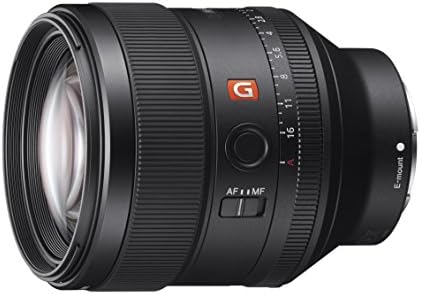 |  |  |  | 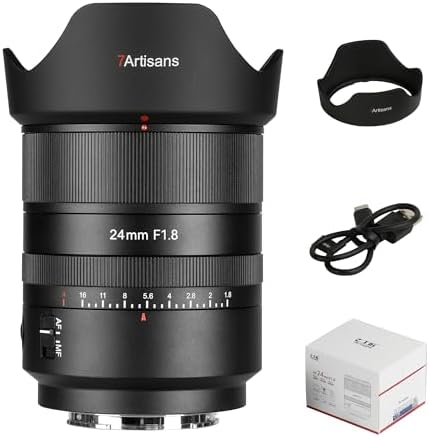 |
|---|---|---|---|---|---|
| Product | Sony FE 85mm f/1.4 GM | Sony FE 16mm f/1.8 G | Canon EF 50mm f/1.8 STM | Tamron 35mm f/2.8 Di III | 7artisans AF 24mm F1.8 |
| Brand | Sony | Sony | Canon | Tamron | 7artisans |
| Best for | Best Overall | Best for Landscapes | Best for First-Time Buyers | Best for Travel | Best for Street Shooting |
| The listing says | Full-frame E-mount lens AF focus 2.79 ft, MF 2.62 ft | 16 mm ultra-wide G lens F1.8 aperture with bokeh | 50 mm focal length, f/1.8 aperture Suited to portraits, action, night shots | Very compact and lightweight High MTF performance for image quality | f/1.8 maximum aperture for low light 14 elements in 11 groups |
| More information | Buy on Amazon | Buy on Amazon | Buy on Amazon | Buy on Amazon | Buy on Amazon |
1. Sony FE 85mm f/1.4 GM Lens (Lens Only)
Best for: Portrait shooters who want a fast, sharp option.
This is the lens with the most listed capability. The f/1.4 maximum aperture lets in a lot of light and gives a soft background when you shoot people up close.
The listing gives a minimum focus distance of 2.79 feet for autofocus, which sets how close you can work with this lens. That’s the reason portrait shooters tend to reach for this focal length. The listed maximum magnification of 0.13x is modest, so this isn’t a macro lens, and it won’t turn a small object into a large one.
The listing also calls out the build: a dust and moisture resistant design and a 820 g weight. That weight is real, so the lens will feel heavy on a small camera body for long shoots. It has a linear autofocus motor, which the listing describes as a focus system, and the single lens design uses one XA element and three ED elements with a Nano AR coating to control sharpness and flare. If you want a lighter standard lens, the Canon 50mm listed below is the lighter route. This lens isn’t the one for travel where weight matters most.
Pros
- Maximum aperture of f/1.4
- Dust and moisture resistant design
- Linear autofocus motor for quiet operation
Cons
- Listed at 820 g, heavier than the others
- Longer focal length suits portraits more than general travel
2. Sony FE 16mm f/1.8 G
Best for: Landscape and interior shooters who need a wide view.
The 16mm focal length is ultra-wide, so it takes in much more of the scene than a standard lens. It pairs high resolution with a soft background at f/1.8. The minimum focus distance is listed at 0.5 feet, so you can get very close to a foreground subject for a dramatic effect.
That close focus is what makes the lens useful for foreground-heavy shots. Put a rock, a fence post or a doorframe a few inches from the front element and it becomes a strong anchor at the bottom of the frame, while the rest of the scene recedes behind it. Interiors benefit in the same way, since you can fit a full room into one frame without backing into a corner.
At 304 g it’s one of the lighter lenses in this group. That helps on long walks. Because it is a wide 16mm view, edges can look stretched and people can look odd if you get close to them, so it isn’t a natural choice for portraits.
The stretching is most noticeable when a person sits near the edge of the frame or when the camera is tilted. If you do need to photograph someone, keep them toward the center and step back, because the distortion grows the closer the subject is to the lens.
Pros
- Ultra-wide 16mm focal length
- Listed at a light 304 g
- Two XD linear motors for fast autofocus
Cons
- Wide focal length can distort faces at close range
- Not a portrait lens
3. Canon EF 50mm f/1.8 STM Lens
Best for: First-time buyers who want a single lens for everyday shooting.
That makes it a good first lens because it trains your eye to compose the way most of the photos you admire were made. The listing gives a maximum aperture of f/1.8. A wide opening lets in more light, so you can keep your shutter speed high enough to avoid blur without pushing the ISO up.
Getting that close lets you fill the frame with a face, a flower or a small object, which is where a 50mm lens shows its strengths. Step back to the minimum distance and you’ll find the background softens noticeably, which is one reason people reach for this focal length for portraits.
The STM motor is quiet, which helps when you shoot video or work in a quiet room. It moves the focus smoothly during recording, so the lens doesn’t hunt or make a noticeable sound on the soundtrack. For still photos, it focuses continuously and without drama.
Note that the listing is for Canon EF mount, so check your camera before ordering. EF lenses fit Canon’s older DSLR bodies. If you own a mirrorless camera with a different mount, this lens won’t fit without an adapter.
Pros
- Classic 50mm standard focal length
- Quiet STM autofocus
- Close focusing to 1.15 feet
Cons
- EF mount, which must match your camera
4. Tamron 35mm f/2.8 Di III OSD M1
Best for: Travelers who want the smallest option.
This is the compact pick. The listing calls it incredibly compact and light, and it adds a 1:2 macro close focus. The f/2.8 maximum aperture is slower than the f/1.4 and f/1.8 lenses, so it gives less background blur and needs more light indoors.
A 35mm view is a flexible middle focal length for street and documentary work. Because it’s light, it’s easy to keep on the camera all day rather than leaving it in a bag, and that alone can mean you catch more of the moments you were traveling to see.
That gives you a single lens that handles everything from broad views to tight, close framing.
The trade-off is light. At f/2.8, you’ll need a higher ISO or a slower shutter speed in dim restaurants, museums and evening streets. If that’s where you shoot most, expect to rely on steady hands or a tripod, or to accept some grain.
Pros
- Compact and light weight
- 1:2 macro close focus
- Moisture resistant construction
Cons
- Slower f/2.8 maximum aperture
If low-light portraits are your main goal, one of the faster lenses above will serve you better.
5. 7artisans AF 24mm F1.8 Camera Lens
Best for: Street and low-light shooters.
This lens lists an f/1.8 aperture and a 24mm focal length, a good middle ground between wide and standard views. The f/1.8 setting also gives you more room to separate a subject from a busy background, though at 24mm the blur will be softer than what you would get from a longer lens.
The listing doesn’t give test results for any of these, so treat them as design intent rather than proven performance, and check sample images from independent reviewers before committing.
The STM autofocus motor is relevant if you shoot video or work in quiet settings, because it runs with little noise and changes focus smoothly. The listing also says the lens minimizes focus breathing, meaning the framing shifts less when focus moves. That matters for video, where a visible change in the frame during a focus pull looks unprofessional.
The USB port lets you update the firmware, which can add compatibility with newer camera bodies. Keep in mind that the port is for firmware, not for changing how the lens performs in a fixed way. The listing also mentions EXIF data transmission, so your camera can record lens information with each image, which helps when you review shots later.
Before ordering, confirm your camera uses the L mount. This is the most important check, because a lens that doesn’t fit your body is simply unusable.
Pros
- f/1.8 maximum aperture
- Optical design with multiple special elements
- USB port for firmware updates
Cons
- L mount only, so check compatibility first
How to Choose in Sixty Seconds
Pick your focal length first
Focal length decides how the lens sees the world. A 16mm or 24mm lens gives you a wide view for landscapes, interiors and groups. A 35mm or 50mm lens is closer to natural vision and works for almost everything. An 85mm lens is for portraits, where it compresses the background and flatters faces. Decide what you shoot most, then pick the number.
Check the full frame prime lenses mount first
Every listing above names a mount, and it’s the one thing you can’t fix later. The Canon is EF mount, the 7artisans is L mount, and the Sony lenses are for E mount. Check your camera’s mount and match it exactly.
Read the aperture number
The f-number tells you how much light the lens gathers and how blurred the background gets. Lower numbers like f/1.4 and f/1.8 are brighter and blur more. Higher numbers like f/2.8 are slower but often smaller and lighter. Choose a bright lens if you shoot in dim rooms or want soft backgrounds, and a slower one if size and weight matter more.
Closing
If you want the lens with the widest maximum aperture, the Sony FE 85mm f/1.4 GM is the strongest listing here, especially for portraits. Its listing gives a maximum aperture of f/1.4 and describes outstanding resolution even at that setting. At 820 grams it’s a substantial lens, so it suits a photographer who plans to carry it deliberately rather than keep it on the camera all day.
The Sony FE 16mm f/1.8 G is the one to get for wide views. At 304 grams it’s far lighter, and its listed minimum focus distance of 0.15 meters means you can get close to a foreground subject while keeping the scene around it. That combination is useful for landscapes, interiors, and street shots where you want to fit a lot into the frame.
Before you order, confirm your camera mount and pick the focal length that matches what you shoot most. Ask yourself which lens you would reach for on an ordinary day. If that answer is a portrait, the longer 85mm will serve you better. If it’s a room, a street, or a landscape, the wider 16mm will. Owning the wrong focal length is the most common reason a fast lens ends up sitting in a drawer.
Related guides
- Best Full Frame DSLR Camera for Beginners: Top Picks for Stunning Photos
- Best Sigma Lens for Sony Full Frame: Top Picks for Stunning Photography
Frequently Asked Questions
What is a prime lens?
A prime lens is fixed at a single focal length, unlike a zoom that covers a range. Because it has fewer moving parts, it can offer a wider maximum aperture in a smaller body. The tradeoff is that you move your feet to change the framing rather than turning a ring. Most people who buy one find that the habit improves how they compose shots.
Do I need a full frame lens for a full frame camera?
Yes, for full coverage. A lens built for a full frame sensor will cover the whole image area, and the listings above are written for full frame use. Some lenses are labeled for APS-C cameras and give a crop on full frame bodies. Check each listing for its sensor coverage before you buy, since mismatched coverage can leave dark corners.
Which focal length is best for portraits?
Most portrait shooters choose a focal length between 50mm and 85mm. The Sony 85mm listed above sits at the longer end of that range, which gives a flattering perspective and a soft background. The Canon 50mm is a lighter option for the same general use. Stand back a little and let the longer focal length do the work.
Are prime lenses sharp enough for everyday use?
Yes. The listings above describe high resolution and multi-element optical designs, which are built for sharp results. Sharpness can vary with aperture, so most lenses are sharpest a stop or two down from their widest setting. For everyday use, any of these picks will serve you well, and the right choice comes down to focal length, mount and weight.