There’s no single best off camera flash for wedding photography. There’s a best one for a particular kind of shooter. Some photographers shoot all day in dark churches and need raw power. Others move fast through receptions and want something small. Some already own a camera brand and need a flash that talks to it. Those three facts decide most of this choice. The products here differ on those points, so the question is less “which ranks first” and more “which fits how you work.”
The two products that split most buyers are the Godox V100 C, for those who want the most power and a touchscreen, and the Godox V480 N, for those who want a lighter body that still gets the job done. Start there.
| # | Product | ||
|---|---|---|---|
| 1 |  | Godox V100 C Top Pick | Check Price |
| 2 | 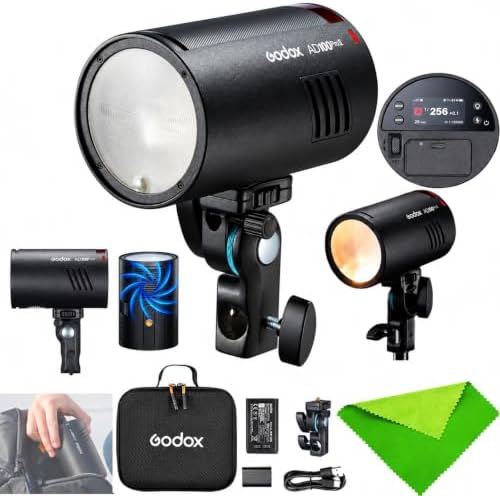 | Godox AD100 Pro II Best for Light Stands | Check Price |
| 3 |  | Godox V480 N Best for Long Shoots | Check Price |
| 4 |  | Godox V1-C Best for Canon TTL | Check Price |
| 5 | 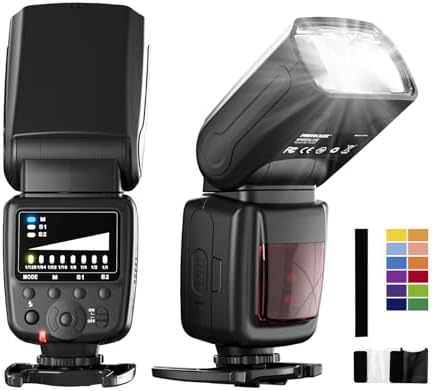 | PHOTOOLEX FK300 Camera Flash Best for Manual Triggering | Check Price |
| 6 |  | PHOTOOLEX FK310 Camera Flash Best for Power Control | Check Price |
| 7 |  | Profoto A10 AirTTL-C Best for Canon Bundles | Check Price |
Table of Contents
Picking an Off-Camera Flash for Your Wedding Photography Situation
If you shoot mostly on camera at events or weddings, the top priority is recycle time and battery capacity, since you need fast, repeatable full-power flashes all day. The Godox V100 C is built for that kind of use, with a fast 1.7-second recycle and a replaceable battery you can swap out in the middle of a shoot.
If you rely on off-camera lighting in a studio or on location, look at how the flash fits into a wireless group setup. The Godox AD100 Pro II is a pocket monolight that can be triggered from X-system transmitters, and its color-coded group indicator makes it easier to keep track of several units at once.
If your gear is already Nikon, the V480 N is worth a close look, because its touchscreen and USB-C charging suit a working photographer who wants everything in one compact body.
1. Godox V100 C
Best for: A shooter who needs strong fill in large or dark venues.
The V100 C lists up to 100Ws in manual mode and 70 to 100 consecutive full-power flashes. For a wedding that runs long, that cooling spec matters more than the peak number. A flash that overheats at the first dance is no use to you. The listing also gives about 1.7 seconds of recycle at full power, so you wait less between frames when the light drops.
The 2.3-inch touchscreen lets you change power, HSS and TTL or manual mode without digging through menus. That matters most when you’re shooting fast and need to adjust on the move. The detachable SU-1 adds direct fill while the main head bounces, which helps in tight indoor spaces where bouncing alone washes out the room. Bounce gives soft, flattering light, but in a low ceiling room it can make everything look flat and grey. Pulling a little direct fill from the SU-1 adds shape back into faces.
The replaceable VB30 battery is the detail to plan around. If you fire at full power all evening, expect to swap batteries partway through. Carry a charged spare in your bag and make the swap a habit during the cocktail hour, when the pace slows and you have a moment to do it without missing a shot.
If your work is mostly outdoor portraits in daylight, the extra power and cooling add size and weight you won’t use. In that case a smaller flash with less output will serve you better and be easier to carry all day.
Good if:
- You shoot indoor receptions or dim churches and need full power.
- You want a spare battery you can swap during the day.
- You want a touchscreen rather than button-heavy menus.
Skip it if:
- You want a small flash to clip on and forget.
- You shoot a camera brand this flash doesn’t list.
2. Godox AD100 Pro II AD100Pro II 100Ws Flash
Best for: A photographer who wants off-camera light stands and a pocket-size unit.
The AD100 Pro II is a monolight rather than a speedlite, so it suits off-camera setups on a stand. That matters most when you want the light placed away from the camera, where a hot-shoe flash can’t go. The listing gives 60 to 100 consecutive full-power flashes and about 490 full-power shots per charge. Those numbers tell you it’s built for a steady pace across a full day of portraits, not just a few quick bursts.
It has a 28 to 85mm adjustable zoom, so you can change beam spread to match the focal length you shoot. Think of it as a way to tighten the light for a close portrait or open it up for a wider frame, without changing your position. The 16-light group ring helps when you run several units at once, since you can see which unit sits in which group and adjust it without hunting through the setup.
It pairs with the Godox X3 and X3 Pro triggers for quick-sync pairing, which the listing says significantly reduces setup time on set. If your triggering needs go beyond X-series, the USB-C port connects an FT433 receiver, sold separately, for 433MHz control. That gives you another route to trigger the unit if your gear runs on that frequency.
Good if:
- You plan to run two or more lights on stands for portraits.
- You want a zoom head to shape the beam.
- You already use Godox X-series triggers.
Skip it if:
- You only ever use one flash on the hot shoe.
- You need a flash that fits your camera’s hot shoe directly.
3. Godox V480 N Flash
Best for: A wedding shooter who walks all day and wants less weight on the strap.
The V480 N is light for a flash with a GN50 rating, and its low weight stands out. At 361g, the V480 N is listed as lightweight for mobility, which helps on a long day.
The flash is rated for up to 650 full-power flashes per charge and recycles in about 1.7 seconds. That recycle speed is what keeps you shooting during a fast moment, like the first dance or a toast, when you can’t wait for the light to catch up. The USB-C charging means you can top it up from a power bank or a laptop between events, which helps when you have no time to swap batteries.
The 2.0-inch touchscreen is paired with physical buttons. Some shooters prefer buttons in a dark reception room, because they can change a setting by feel without looking at the screen. Others prefer the touchscreen for quick changes. You’ll know which you prefer only after you have used it at night, so try both before the wedding.
The bounce head tilts from -7 to 120 degrees and rotates 330 degrees. That range lets you bounce off a low ceiling, a wall, or a card held behind the flash. Bounce is the main way to get softer light in a room where direct flash looks harsh, so the extra angles are useful when the room has a light-colored ceiling and you want the light to come from above and to the side.
The built-in 2.4GHz X system works as both transmitter and receiver across 32 channels. You can trigger the flash off camera without buying a separate commander, which saves a piece of gear to carry. Set the channel on the camera and the flash to match, and check that they agree before the ceremony starts, since a mismatched channel is the most common reason an off-camera flash fails to fire.
Good if:
- You want a flash that’s easy to carry on a long day.
- You like having both a touchscreen and physical buttons.
- You shoot a Nikon body on the compatibility list.
Skip it if:
- You need the extra power of the larger Godox units.
- You shoot a camera brand outside the Nikon list.
4. Godox V1 V1-C V1C TTL Camera Flash
Best for: A Canon shooter who wants a flash that matches the camera’s TTL system.
The V1-C is built for Canon E-TTL II and supports a long list of Canon bodies. It has a round flash head that the listing says gives softer, more even light than a standard flat head. That helps when you can’t bounce the flash and need the light to fall off gently across a face.
The listing gives 1.5 seconds of recycle and 480 full-power shots. It includes TTL auto flash, manual mode, 1/8000s high-speed sync, exposure compensation and exposure lock, and second-curtain sync. The modeling lamp steps from 01 to 10, so you can preview the light before you fire. It can be used on or off the camera through the built-in Godox 2.4G X system, which means the same unit can act as a receiver on the hot shoe or as a standalone light on a stand.
Exposure lock matters most when the light changes between frames. If you lock the flash reading on your subject and then recompose, the flash keeps the power it measured instead of recalculating for the new framing. Second-curtain sync is the setting to choose when you want motion blur to trail behind a moving subject rather than lead it.
Good if:
- You shoot a Canon body on the listed compatibility list.
- You want a round head for softer light.
- You need TTL with exposure lock for changing light.
- You plan to trigger the flash off the camera and want the built-in X system to do it.
Skip it if:
- You need the most power in a large venue.
- You shoot another brand.
- You want a flash whose output you can judge by the listing alone. The compatibility list is long, so check your exact body against it before you buy.
5. PHOTOOLEX Camera Flash Speedlite FK300
Best for: A budget-minded shooter who wants a manual flash with wireless triggering.
The FK300 has a GN33 guide number and an 8-level manual power range from 1/128 to 1/1. It supports S1 and S2 wireless modes, so you can fire it off camera without a separate trigger. The listing says it works with Canon, Nikon, Sony, Panasonic, Olympus, Fujifilm, Pentax and Leica through a standard hot shoe.
The kit includes a pouch, a flash stand and 12 color filters. The listing also states a 24-month warranty. It has no TTL, so you set exposure by hand, which suits photographers who already meter their scenes.
Manual mode is the main reason to consider this flash. Instead of the camera deciding the output for each shot, you choose the power level yourself and check the result on your camera’s screen or histogram. That takes a little practice, but it gives you the same output every time, which helps when you’re matching several flashes or repeating a setup across a shoot.
The 8 power levels step down in halves, so each step from 1/1 to 1/2 changes the output by the same amount. Start at a middle setting, take a test frame, and adjust one step at a time. The LED indicators show the current level, so you can confirm a change without digging through menus.
Wireless S1 and S2 modes are the other practical advantage. S1 fires when it detects the light from another flash, and S2 fires on the first flash in the group, which means one flash on camera can trigger the FK300 off to the side. In a small studio or a living room, that’s often enough to add a second light without buying a separate radio trigger.
Good if:
- You’re comfortable setting exposure manually.
- You want a kit with a stand and filters included.
- You shoot a camera brand outside the Godox ecosystem.
Skip it if:
- You need TTL automatic exposure.
- You need a large light output for big dark venues.
6. PHOTOOLEX Camera Flash Speedlite FK310
Best for: A manual shooter who wants finer power control and a display.
The FK310 shares the GN33 rating with the FK300, but adds an LCD screen that shows mode, power and battery status. That matters most when you’re working quickly, because you can check each setting without guessing from a few small indicator lights.
Its 22-level power adjustment runs from 1/128 to 1/4, which gives finer steps than the FK300’s 8 levels. In practice, the extra steps let you dial in exactly the output you want. If the subject is a little too bright, you can drop the power by a small amount rather than jumping to the next coarse setting. That precision is the main reason to choose this model over its sibling.
The listing also includes a Multi mode for stroboscopic effects, with adjustable frequency. Use it when you want repeated flashes captured in a single frame, such as a figure in motion. Manual mode is the right choice for controlled lighting, while Multi suits creative shots where the repeated bursts are part of the look.
The 3.5mm sync port is worth a closer look if you rely on wired off-camera triggering. Plug a sync cable from the camera to the flash and the flash fires with the shutter. Many setups today use wireless triggers instead, so check whether your current gear still needs a cable before you count this port as a deciding feature.
The kit includes the same pouch, stand and 12 color filters, with the same stated 24-month warranty. Like the FK300, it has no TTL, so you set the power yourself every time.
Good if:
- You want finer manual power steps than the FK300 offers.
- You prefer an LCD to read settings at a glance.
- You use wired off-camera triggering.
Skip it if:
- You need automatic TTL exposure.
- You want the most power for large venues.
7. Profoto A10 AIR-TTL Camera Flash Light Compatible
Best for: A Canon shooter who values a premium flash and a rich accessory bundle.
The A10 AirTTL-C is a 76Ws flash with a 9-stop power range and a full-power recycle of about one second. That fast recycle matters when you’re shooting bursts or working through a session, because you wait less time between frames. The listing gives 450 full-power flashes on a lithium-ion battery, with an 80-minute recharge. Its flash durations run from 1/800 to 1/20,000 second, which helps with motion freezing. A shorter duration stops movement more sharply, so this range gives you room to freeze fast action.
The head is 2.75 inches round, with tilt and rotation, and it auto-zooms from 32 to 105mm. Auto-zoom sets the beam to match your lens, so you don’t have to adjust it by hand each time you change focal length. The LED modeling light helps you preview the light before you fire. The AirTTL system works on and off camera with wireless control up to 1000 feet, and it’s compatible with various Profoto lights. The listing says this bundle is a curated set of items and may need extra accessories for your setup, so check what is included before you order.
Good if:
- You want auto-zoom and a round head with an LED preview.
- You shoot Canon and want a premium flash.
- You want the bundle accessories included.
Skip it if:
- You need more than 76Ws for large venues.
- You want an all-in-one kit with nothing else to buy.
Where These Overlap
The Godox V480 N and Godox V1-C are close for a Canon or Nikon shooter who wants a compact TTL speedlite. Both recycle quickly enough for steady shooting, and both list around 480 to 650 full-power flashes. The choice between them comes down to which camera brand you own, since each is listed for a different system. If you shoot Canon, the V1-C is the one on your list. If you shoot Nikon, the V480 N is.
The PHOTOOLEX FK300 and FK310 overlap almost completely. Both carry the GN33 rating, the same kit, and the same warranty. The difference is the FK310’s LCD and finer 22-level power steps. If you want a screen and finer control, the FK310 is the one that separates from the FK300.
The Godox V100 C and Godox AD100 Pro II are different tools. The V100 C is a speedlite for the hot shoe, and the AD100 Pro II is a monolight for stands. A shooter who needs one flash on camera should look at the V100 C. A shooter building an off-camera setup should look at the AD100 Pro II.
Still Not Sure?
How often will I really use it?
If you shoot weddings most weekends, power and battery life matter more than size. A flash that holds 70 to 100 full-power shots without overheating will serve you through a long reception. The Godox V100 C is built around that kind of steady use, with a spare battery option. If you only shoot a few weddings a year, a lighter unit like the Godox V480 N may be easier to carry. Pick the one that matches the days you actually work.
What do I already own that this has to work with?
Your camera brand matters more than almost anything else here. The Godox V1-C is listed for Canon bodies, and the Godox V480 N for Nikon. The PHOTOOLEX units list a wide range of brands through a standard hot shoe. Check the compatibility list before you buy. If you already use Godox X-series triggers, the AD100 Pro II and the V100 C fit that system directly.
What am I most likely to regret choosing?
Most people regret buying too little power for a dark venue, or buying a flash that doesn’t talk to their camera. A manual-only flash like the PHOTOOLEX FK300 or FK310 can frustrate a shooter who relies on TTL. If you think you’ll want automatic exposure, pick a TTL flash such as the Godox V1-C or the Profoto A10 AirTTL-C. If you know you’ll shoot large dark spaces, the Godox V100 C is the safer pick.
Closing
Two situations split most buyers. The first is the shooter who needs raw power for dark venues, and for them the Godox V100 C fits the job. Its 100Ws output and the spare-battery option matter most when a wedding or event runs long and the light has to keep firing. The second is the shooter who walks all day and wants a lighter flash, and the Godox V480 N fits that need. At 361g it adds little weight to the bag or the camera, which counts for travel and all-day shoots more than raw output does.
Before you decide, confirm your camera brand against each product’s compatibility list. A flash that fits the hot shoe mechanically can still lack the TTL or wireless features you expect with your body, so check the listed models rather than assuming. The wrong brand is an easy mistake to make when a product looks right on the page.
Then pick the one that matches the venues you shoot most. If your work is mostly dim indoor receptions and large rooms, lean toward the higher-output option. If your work is mostly outdoor sessions, travel and small rooms, the lighter unit with enough power for those spaces is usually the better fit. Matching the flash to your real locations will serve you better than choosing by the highest number in the listing.
Frequently Asked Questions
What power do I need for a dark wedding venue?
A flash with more output helps in large or dim spaces. The Godox V100 C lists up to 100Ws in manual mode and 70 to 100 consecutive full-power flashes, which is built for steady use. The Godox AD100 Pro II is also rated at 100Ws and suits off-camera setups on stands. For a smaller room, the Godox V480 N with a GN50 rating may be enough. Match the power to the largest room you expect to shoot.
Does the flash work with my camera?
Compatibility depends on the brand and model. The Godox V1-C is listed for many Canon EOS bodies, including R5, R6 and 80D. The Godox V480 N lists a long range of Nikon bodies, including the Z series and D-series. The PHOTOOLEX FK300 and FK310 are listed for Canon, Nikon, Sony, Panasonic, Olympus and Fujifilm through a standard hot shoe. Check the full compatibility list on each listing before you buy.
Do I need a separate trigger for off-camera flash?
It depends on the flash. The Godox V100 C, V480 N and AD100 Pro II use the built-in 2.4GHz X system, so they can trigger each other without a separate unit. The PHOTOOLEX FK300 and FK310 use S1 and S2 modes, which fire on the light from another flash. Some setups also need a trigger on the camera. If you plan to shoot off camera, check how each flash receives its signal.
How do I keep the battery going through a full wedding day?
Carry a spare battery and keep the flash off between shots. The Godox V100 C uses a replaceable VB30 battery, so you can swap it during the day. The Godox V480 N lists up to 650 full-power flashes on a USB-C battery, and the Profoto A10 AirTTL-C lists 450 full-power flashes with an 80-minute recharge. Charge overnight before each wedding, and bring a backup if you shoot long days.