Tripod ladders look simple, but the models on Amazon differ a lot. Some are built for climbing, some for reaching fruit, and some are really work platforms. The real split is between light-duty orchard ladders and sturdier fiberglass or work-grade models.
Good all-round pick: Louisville Ladder FT1506 Tripod, because its listing pairs non-conductive fiberglass with a bonded, slip-resistant boot and a 300-pound rating.
Best orchard pick: Sunbiaouk Aluminum Orchard Ladder, because it’s built for picking and folds down small.
Best for tall reach: Werner FTP6212 Tripod Ladder, because its listing gives the greatest reach height of the group.
This guide is for people who want a clear answer on which tripod ladder fits their job, whether that’s pruning, picking fruit, or working around the house.
Table of Contents
How We Picked
A listing had to say what the ladder is made of, what it can hold, what is included, and how it’s built. Products with thin or unclear listings were set aside.
That rule matters because a listing is the seller’s own description, and not every seller describes the same things. Some name a load capacity, such as 300 pounds or 330 pounds, while others leave it out. A number on the page gives you something to compare; a missing number tells you to check the product before you buy it. We treated a stated capacity as a real point in a ladder’s favor and a missing one as a gap.
Material was the next filter. Fiberglass, aluminum alloy, and galvanized steel each appear in these listings, and the listings describe them differently. Fiberglass is described as non-conductive, which matters if you work near power lines. Aluminum is described as resistant to rust. Galvanized steel is described as resistant to deformation and rust in damp conditions. We didn’t rank these materials against each other, because the listings give no basis for saying one is better overall. We only checked that each product named its material clearly.
We also looked at the features a listing described in concrete terms: a widened top platform, footrests, a safety chain, non-slip feet, a folding design. Where a listing gave a specific height setting or a step count, we noted it. Where a listing used general words like “sturdy” or “durable” without a supporting fact, we didn’t give that claim much weight.
If you’re checking a listing yourself, use the same test. Look for the material, the load rating, what the package includes, and how the ladder is built. If those four facts are present, you can compare the product fairly. If they’re not, the listing alone can’t tell you whether the ladder is right for you.
Comparison Table
| # | Product | ||
|---|---|---|---|
| 1 |  | Louisville Ladder FT1506 Tripod Top Pick | Check Price |
| 2 |  | Werner FTP6212 Tripod Ladder Best for Trimming | Check Price |
| 3 |  | Sunbiaouk Aluminum Orchard Ladder Best for Uneven Ground | Check Price |
| 4 | 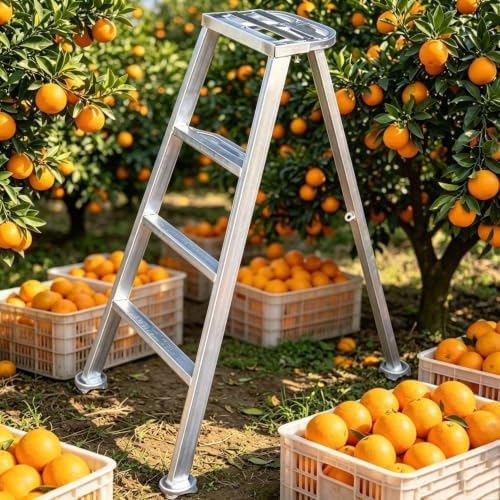 | Dalumian 4 Step Orchard Ladder Best for Pruning | Check Price |
| 5 |  | Dexinhdh Tripod Orchard Ladder Best for Wide Platforms | Check Price |
| 6 |  | Patio Pruning Tripod Ladder Best for Patio Use | Check Price |
| 7 |  | IRONMAX Folding Work Platform Best for Garage Work | Check Price |
1. Louisville Ladder 6-Foot Fiberglass Tripod Ladder
Best for: Homeowners who want a sturdy, non-conductive ladder for everyday work.
This ladder is made of fiberglass, which the listing calls non-conductive. That matters if you work near wiring. The center pull spreader brace makes it easier to carry and set up. The listing also mentions inside spreader braces that protect the ladder during transport, which helps keep the rails in good shape between jobs.
The Shox system is described as adding durability and resistance to rough handling. The raptor boot protects the upper rails, and the bonded tread is meant to grip well. If you need more height, look at the Werner instead.
Pros
- Non-conductive fiberglass rails
- Center pull spreader brace for easy handling
- Bonded, slip-resistant tread
- 300-pound rating stated
Cons
- Shorter reach than the Werner model
2. Werner 12 ft. Fiberglass Tripod Step Ladder
Best for: Anyone who needs extra reach for trimming or working at height.
The listing gives this ladder a 16-foot reach height, the tallest of the group. That number is what sets it apart, and it matters most when the work sits above what a shorter ladder can reach. It’s made from fiberglass and carries a load rating that you should check against your own weight plus your gear. The listing describes this ladder’s fiberglass as non-conductive, though it doesn’t say the ladder is rated for work near power lines.
A single rear rail lets it sit where other ladders can’t, which the listing says helps in tight spaces. Think of a narrow strip between a fence and a bed, or a spot beside a wall. In those places a two-rail ladder may not fit at all, so the single rail is the feature doing the work. The spread handle is meant to speed up setup. Instead of unfolding each leg one at a time, you open the handle to set the legs, which saves time when you move the ladder often.
The Traction-Tred steps are riveted for grip, and a molded rail shield guards against scrapes. The listing says it’s solid on uneven ground, which suits fruit picking and tree trimming. Uneven ground is common in orchards and yards, where a ladder with fixed footing can rock.
If you only need low height, the Louisville is a simpler choice. A taller ladder gives more reach, so a shorter model is the better fit when you rarely work high.
Pros
- 16-foot reach height
- Single rear rail for tight spots
- Riveted Traction-Tred steps
- Molded rail shield
Cons
- The single rear rail may suit tight spots better than open ground, per the listing’s own description
3. Sunbiaouk Aluminum Orchard Ladder
Best for: Home growers picking fruit from trees in the yard.
This is an aluminum folding ladder with a widened top platform and side footrests. The top platform gives you a wider place to stand and reach, and the footrests give you a spot for your feet while you work the branches.
The pads are meant to grip the ground, which helps when the yard is uneven, and the telescopic bar lets you set the height to match the tree you’re picking from. Before you pick, set the ladder to a height that puts the fruit within easy reach so you aren’t stretching from the top.
The listing doesn’t say how the chain is attached or how it’s meant to be used, so read the printed instructions that come with the ladder before your first use.
That makes it a good fit for people with limited storage, since you can fold it away after the harvest and tuck it into a small space.
The listing presents it for outdoor picking and garden pruning, so it’s the orchard-focused option of the group. If your job is a long cut, a rough trim on a large limb, or any task that puts heavy loads on the platform, look at a heavier-duty ladder instead. The listing also says it works for apples, lychees, and similar fruit, so it suits a range of tall fruit trees in a home yard.
Pros
- Widened top platform and footrests
- Adjustable telescopic support bar
- Safety chain included
- Folds for small storage
Cons
- Aluminum build suits picking more than heavy-duty work
4. Dalumian 4 Step Orchard Ladder
Best for: Gardeners who prune high branches and want a compact ladder.
This four-step ladder stands 1.2 meters tall, or 47.24 inches. The listing describes a widened top platform with footrests, which it says reduces the risk of falls. That matters most when you’re reaching into the upper canopy, because a wider platform gives you a place to stand while your weight shifts toward the branches you’re cutting.
The rear support legs fold back, which the listing says makes it easy to store in tight spaces.
The lotus-shaped base is meant to dig into soil for stability. That only helps on soft ground. On hard or paved surfaces the base won’t bite, so the ladder will rely on its footing alone. Check the ground before you climb, and avoid using it on slopes where the legs will sit unevenly.
The listing also suggests it works for hedge pruning. For hedges, the same height and wide platform apply, but move the ladder often instead of leaning it at a stretch.
If you need a model with a fiberglass build, the Louisville is the better match, while this one’s rear legs fold back for tight storage spaces.
Pros
- Galvanized tubing with a listed 220 to 330 pound capacity
- Rust-treated surface
- Rear legs fold back for storage
- Lotus-shaped base
Cons
- Galvanized build is heavier than the aluminum options
5. Dexinhdh Tripod Orchard Ladder
Best for: Fruit growers who want a wide top platform.
The triangular support structure is listed as resisting tipping and sliding. That matters most when you’re reaching sideways from one spot, because a ladder that leans or skids under a shifting load is what turns a routine pick into a fall. The widened top platform and footrests are meant to reduce falls by giving you a more stable place to stand and a clearer footing as you work higher.
The lotus-shaped feet are described as firmly anchored to the soil, which helps on lawns and in orchard rows where the ground isn’t level. Set the feet down before you climb, and keep an eye on the ground beneath each one, since a soft spot on one side can still shift the whole frame.
The rear support legs fold back when the ladder isn’t in use. That’s the practical reason to consider it for a home with limited storage, because the folded shape is what lets it fit in a small space between uses.
Its galvanized pipe construction is listed as strong under long-term use, with good load-bearing capacity and resistance to deformation. The listing says it suits orchards, gardens, and uneven ground, and can be used for picking apples, pears, peaches, and oranges as well as for pruning branches and hedges. Those uses are a good fit if you move between harvesting and yard work with the same ladder.
If you want a lighter model, the aluminum Sunbiaouk is the better match.
Pros
- Triangular support structure
- Widened top platform
- Lotus-shaped non-slip feet
- Foldable for storage
Cons
- Galvanized pipe adds weight compared with aluminum
6. Patio Pruning Tripod Ladder
Best for: Patio and garden users who need a height-adjustable ladder.
This three-step ladder has an adjustable telescopic pole with five height settings. The listing says you can also change the opening angle, which lets you set the legs for the spot you’re working in. Pick the height first, then choose the angle that keeps the ladder level on your ground.
Once the height is set, connect the safety chain. The chain is what keeps the ladder from spreading further than you intend while you work above it. Connect it every time you climb, not just on uneven ground, because a ladder that stays put with your weight on the top step is the one that matters most.
Each foot has four grappling hooks, which the listing says help it grip slopes. The hooks are meant to bite into soil, so they work best on garden beds and lawn. On a hard patio, the feet rely more on their own grip, so test the ladder with a small push before you climb.
The aluminum alloy frame is described as rust-resistant. That matters if the ladder will live outside through wet seasons. Store it under cover between jobs, since a frame that’s rust-resistant is still easier to keep in good shape when it stays dry.
The widened workbench and footrest are meant for longer jobs. A wider step gives you room to stand square while you cut, and the footrest on the opposite side helps you move around the tree without stepping down each time. If your work is quick, you may not notice these features; if you spend an hour pruning, they make the difference.
It’s a generic-brand product, so check the listing details before buying, especially the load rating and the leg-spread range. Confirm that the height you need falls within the five settings. For a larger top platform, the Dexinhdh model is a closer match.
Pros
- Five adjustable height settings
- Safety chain included
- Four grappling hooks per foot
- Aluminum alloy frame
Cons
- Three steps give less reach than the taller models
7. IRONMAX Folding Work Platform
Best for: Garage, painting, and car-washing jobs that need a stable platform.
This is a folding aluminum platform rated at 330 pounds. The listing says it folds in seconds and weighs 8 pounds, which makes it easy to move between jobs. Raised anti-slip strips and non-slip pads on the legs add grip, and safety locks are included.
The rating is the number to check first. A 330-pound capacity is the load the platform is built to hold while you stand on it, and that figure has to cover you plus any tools, paint cans, or materials you set on it. If you’re heavier than average or plan to stack equipment on the top, add up the weight before you start rather than guessing.
The stability features are there for a reason. The listing describes a reinforced crossbeam at the base and side steps braced with tripod-style supports. Together with the four leg pads, these are meant to keep the platform steady on a hard floor. Before you climb, confirm the safety locks are engaged and the legs sit flat, and make sure the surface is level. A platform that rocks on an uneven garage floor is a fall risk no matter how strong the frame is.
The listing also says it can serve as a workbench or small table while camping. It’s a platform rather than a climbing ladder, so use it for standing work only. For fruit picking, the orchard models are a better fit.
Pros
- 330-pound rated aluminum frame
- Folds in seconds, weighs 8 pounds
- Anti-slip strips and leg pads
- Safety locks included
Cons
- A platform, not a climbing ladder
How to Choose in Sixty Seconds
Decide on the job first
If you’re picking fruit, an orchard ladder with a wide top platform fits best. If you need a work platform for painting or car washing, the IRONMAX model is the better pick. Match the tool to the job before you compare details.
Start by naming the job you do most often. A fruit picker works best with a tripod that sits solidly on uneven ground and has a platform wide enough to stand on while you reach. A painter or someone washing a car needs a flat, stable surface at a steady working height, not a ladder built to be pulled into branches.
If you only have one job in mind, you can rule out most of the list in a minute. If you plan to use one ladder for both orchard work and home projects, look first at the platform width and footrests, since those are the features that change how safe the ladder feels in use.
Check height and reach
Reach matters more than step count. The Werner lists the greatest reach height, so it suits trimming and tall work. The shorter Louisville is simpler to store and handle for everyday tasks.
Read the reach figure, not just the number of steps. A ladder can have few steps and still reach high if its frame is tall, and a ladder with many steps can reach less than you expect. Compare the listed reach against the height of the branches or fixtures you plan to work on.
Think about where you’ll store and carry it, too. A taller ladder gives more reach but takes more room in a garage or shed, and it’s harder to move between trees. If your work is mostly low, a shorter model will feel steadier and be easier to manage alone.
Confirm material and capacity
Fiberglass suits work near wiring, aluminum saves weight, and galvanized steel adds strength. Check the listed weight rating against your needs before you order.
Material changes what the ladder is good for. The Louisville listing describes its fiberglass as non-conductive, which is the material property to check if you work near wiring. Aluminum is lighter, which helps when you carry it through an orchard. Galvanized steel is heavier but sturdy, and it’s the material to favor if the ladder will take hard daily use.
Add up the weight of the person and whatever they’ll carry up the ladder, such as a full picking bag or a case of tools. Choose a rating that covers that total with room to spare. The capacity printed on the product is the limit to respect, not a target to approach.
Related guides
Frequently Asked Questions
Is a fiberglass tripod ladder safer than aluminum?
Fiberglass is non-conductive, which the Louisville and Werner listings both note. That helps if you work near wiring. Aluminum is lighter, so it’s easier to carry. The right pick depends on whether electrical contact or weight matters more to you.
How much height do I need?
Measure the highest point you need to reach. The Werner lists a 16-foot reach height, which suits tall trimming. The Dalumian and Dexinhdh orchard ladders are shorter and fit lower picking. Choose based on the work, not the largest number.
Can I use an orchard ladder for home repairs?
Orchard ladders are built mainly for picking and pruning. The Sunbiaouk and Dalumian listings describe garden and harvest use. For painting or repair work, the IRONMAX platform is the closer match, since its listing describes that kind of job.
Do these ladders store easily?
Most of these ladders fold. The Dalumian and Dexinhdh listings say the rear legs fold back, and the Sunbiaouk folds for a shed corner. Check the folded size in each listing if storage space is tight.
Closing
The best overall pick is the Louisville Ladder FT1506, because its fiberglass build and bonded tread suit everyday home work. Its non-conductive fiberglass rails, shox system and raptor boot are built to take the knocks of regular use, and the thick tread gives slip-resistant footing on the bottom steps.
If you need more reach, the Werner FTP6212 is the next step up. Its 16 ft. reach height goes well beyond the Louisville’s 6-foot model, and its single rear rail lets it sit where other ladders can’t, which helps in tight spaces. It’s also solid on uneven ground, so it can be positioned closer to a tree.
Think about the job you have most often, then choose the ladder built for it. A ladder that suits a single weekend of fruit picking may not be the right fit for a daily routine of painting, pruning or garage work. Matching the ladder to the task you repeat most will serve you better than choosing for the job you do once a year.
Check the current price on Amazon before you buy.