The Sony SEL35F18 35 mm f/1.8 Prime is a fixed lens for Sony’s APS-C cameras, and it’s the one lens many owners buy to stop using the kit zoom that came in the box. Its listing leads with three things: a compact, lightweight body, a bright f/1.8 aperture, and built-in Optical SteadyShot stabilization. Sony also calls the autofocus silent and smooth, which is the sort of claim that matters most to people who shoot video as well as stills.
The owner this lens is built around shoots indoors, in the evening, or anywhere the light is thin, and wants a picture without reaching for a flash. They’d leave it on the camera for weeks at a time, carrying it to family gatherings, out on the street, and on trips where one small lens has to cover everything. The trade-off is the one every fixed lens asks for: no zoom ring, so the only way to frame tighter or looser is to move your feet, and the 35 mm focal length is a decision you make once and live with. Whether that’s a fair swap depends on what you shoot, and the sections below settle it.
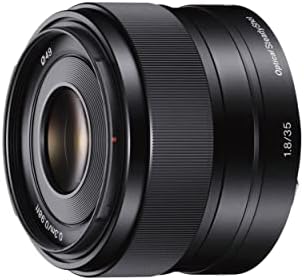
Table of Contents
Who Should Buy This Prime Lens
The first buyer is someone who owns an APS-C Sony body and has been shooting with the zoom that came with it. They like taking pictures indoors, at birthdays and dinners, where the kit lens struggles and the built-in flash flattens everyone’s face. The f/1.8 aperture is the whole point for them, because it lets in more light and it also blurs the background behind a portrait. Sony lists the angle of view at 44 degrees on APS-C, which is a natural, unexaggerated framing — close to what your own eye notices when you look at a scene.
The second buyer shoots video as much as stills. Sony’s listing describes the focusing as silent and smooth, and calls it ideal for shooting movies, so the lens motor won’t intrude on a quiet clip the way a noisy one would. The same buyer benefits from Optical SteadyShot, which is built into the lens rather than the camera body, so handheld footage has some help even on a body without stabilization of its own.
The third buyer travels light. Sony calls this a compact, lightweight fixed lens, and a fixed lens has fewer moving parts and less glass than a zoom covering the same range. Someone who walks a city all day with one small bag is exactly who that line is written for.
Two people should skip it. The first is anyone who shoots sport, wildlife or school plays from the back of a hall, because the listing says plainly that the framing cannot be changed and the reach is set. They need reach, so they should look for a telephoto zoom instead. The second is anyone who mostly shoots wide landscapes and wants a sweeping view in one frame; at 44 degrees this lens gives a normal view, so a wide prime or a wide zoom suits them better.
What the Sony SEL35F18 Gives You
Sony’s listing groups into a few clear jobs, and it’s worth taking them one at a time rather than in the order the bullets appear.
Getting a usable picture when the light is poor
The headline here is the f/1.8 maximum aperture. Aperture is the hole light passes through, and a larger hole means the camera can use a faster shutter speed or a lower sensitivity setting in the same dim room. For the owner shooting indoors in the evening, that’s the difference between a sharp frame and a blurred one, and it’s the single reason most people buy this lens.
Sony pairs that with Optical SteadyShot, stabilization built into the lens itself. Stabilization counteracts the small shake of your hands, so handheld shots at slower shutter speeds have a better chance of coming out clean.
Sony also says the new optical design gives excellent peripheral sharpness and contrast, meaning the corners of the frame, not just the middle. That matters most in landscape and group shots, where the edges carry real detail. The listing gives the construction as 6 elements in 8 groups, and the minimum focus distance as 0.99 ft (0.3 m).
Filling the frame with a subject
The 0.99 ft minimum focus distance is worth translating. You can get roughly a foot from your subject and still focus, which is close enough for food on a table, flowers, or a detail shot of hands at work. Sony lists the maximum magnification ratio at 0.15x, so this is close-up work rather than true macro — a coin or an insect at life size is beyond it, and anyone who wants that should look at a dedicated macro lens instead.
The f/1.8 aperture does a second job here. Wide open, it throws the background out of focus, which separates a face from a busy street behind it. That’s the portrait use the listing names, and it’s the reason a portrait photographer reaches for a fast prime rather than a zoom.
The focal length is the constraint to understand. Sony gives the focal length as 1.38 in and the APS-C equivalent as 52.5 mm. That equivalence is the useful number: on an APS-C body this lens frames like a standard lens, roughly what you see with one eye, which suits portraits, street scenes and everyday walkaround shooting. It’s not wide and it’s not long.
Shooting video without the lens getting in the way
Sony describes the focusing as silent and smooth, high speed, and ideal for shooting movies. In practice that means the lens can track a subject without the motor noise bleeding into your audio, and without the visible jump a slower focus motor produces mid-clip. For anyone recording interviews, family moments or vlogs, that’s the feature that keeps footage usable.
The listing also mentions direct manual focus: if autofocus can’t lock on or picks the wrong subject, you step in and take total control by turning the focus ring.
One limit is stated outright — the lens is not zoomable — so framing is your feet and your position, nothing else.
The full list of listed details sits below.
| # | What Amazon lists |
|---|---|
| 1 | Compact, lightweight fixed F1.8 lens.Angle of View (APS C) 44 ° |
| 2 | Minimum Focus Distance : 0.99 ft (0.3 m), Maximum Magnification ratio : 0.15x, Focal Length : 1.38 in |
| 3 | New optical design for excellent peripheral sharpness and contrast, Built in image stabilization |
| 4 | Silent and smooth high speed focusing ideal for shooting movies. Superb focusing operation |
| 5 | Lens group or elements is 6/8. If auto focus cant lock on or focuses on the wrong subject, step in and take total control with direct manual focus.Image stabilization (SteadyShot):Optical SteadyShot |
| 6 | Format: APS-C, 35 mm equivalent focal length (APS-C): 52.5 mm |
| 7 | Lens not zoomable |
Sony SEL35F18 35 mm: Strengths and Limits
Pros
- f/1.8 aperture suits dim rooms and indoor portraits
- Optical SteadyShot stabilization built into the lens
- Silent, smooth focusing Sony calls ideal for movies
- Compact, lightweight fixed design for travel
- 0.99 ft minimum focus distance for close-up work
Cons
- Not zoomable, so framing means moving your feet
- Maximum magnification 0.15x, so no true macro
- Fixed 52.5 mm equivalent framing rules out wide shots
Is the Sony SEL35F18 35 mm Worth Buying?
Buy it if you own an APS-C Sony body, shoot indoors or in low light, and want one small lens that stays on the camera. Skip it if you need reach or a wide view, because the listing is clear that you cannot zoom and the framing is set.
For the indoor and family shooter, the answer is yes. The f/1.8 aperture and Optical SteadyShot both attack the same problem from different sides — one lets in more light, the other steadies your hands — and together they cover the evenings, the restaurants and the winter afternoons where a kit zoom gives up. Add the silent focusing and this same buyer can record a clip without the lens announcing itself on the soundtrack.
For the traveler, the answer is a qualified yes. Sony calls it compact and lightweight, and a fixed lens carries less to haul around than a zoom. But the trade is real: every shot is taken at the same framing, and the only zoom is your legs. Someone who photographs architecture or wide landscapes will feel that limit on the first day.
The central trade-off, then, isn’t about quality — it’s about whether one focal length is enough for the way you shoot. A zoom buys flexibility and gives up light. This lens does the opposite, and it does it in a small body with stabilization inside. If most of your pictures happen within a few steps of where you’re standing, you won’t miss the zoom. If your subjects are far away or your scenes are wide, you will, and a zoom covering a broader range is what to look for instead.
Two numbers tell you what that one framing actually is. On APS-C the lens behaves like a 52.5 mm lens on a full-frame camera, so it sits just past the standard view — slightly tighter than the eye, which is why it flatters faces and feels cramped in a small room. And the closest it will focus is 0.99 ft (0.3 m), so you can fill the frame with a face or a plate of food, but not with a stamp.
Know what you give up when you buy it. The lens is not zoomable, and the angle of view is 44°. If you already own a zoom that covers 35 mm, this lens does not replace it — it replaces the hours after dark when that zoom stays in the bag.
If autofocus locks onto the wrong subject, or refuses to lock at all, the lens has an answer built in: direct manual focus. Step in and take total control. That matters most in low light, which is exactly when you bought this lens.
Frequently Asked Questions
Does this lens need any maintenance or refills?
No refills and no consumables — a lens has nothing to replace the way a printer has ink. What it does ask for is basic care: keep the glass clean with a proper cloth, and cap it when it’s in the bag. There’s no filter included in the listing, so if you want one for protection, that’s a separate purchase.
Will it work on my Sony camera?
It works on Sony’s APS-C bodies, the format the listing names. The listing gives the APS-C equivalent focal length as 52.5 mm and the angle of view as 44 degrees. On a full-frame Sony body the lens still mounts, but the camera crops to the smaller APS-C area.
What’s in the box, and what do I need to buy separately?
The listing describes the lens and its optical and focusing features, but it doesn’t itemize the box contents. Check the included accessories on the product page before you order. A front cap, rear cap and lens hood are the usual companions to a lens like this.
Is a fixed lens like this actually worth owning?
Yes, for the right shooter. Sony’s listing describes this one as compact and lightweight with an f/1.8 aperture. The owner who benefits is the one who shoots people, interiors and everyday scenes rather than distant subjects. If you’d rather never move your feet, a zoom is the honest answer.
Can I use it for video on a camera without stabilization?
Yes. Optical SteadyShot is built into the lens, not the camera, so it works on a body that has no stabilization of its own. Sony also describes the focusing as silent and smooth and ideal for movies, which matters when you’re recording sound close to the camera. Neither feature replaces good technique, but both give handheld footage a better starting point than an unstabilized, noisy-focusing lens would.