Modern photography relies on more than just the camera body. The lens mount type is a key feature that affects compatibility, performance, and creative options. If you want to change lenses or use older glass, understanding mounts will save you time and money. Many beginners think all lenses fit every camera, but that’s a costly mistake.
Table of Contents
What Is A Camera Lens Mount?
A lens mount is the mechanical and electronic connection between a camera and its lens. Each brand and system uses its own design. The mount ensures the lens fits securely, communicates with the camera, and lets you swap lenses quickly.
Popular Camera Lens Mount Types
There are dozens of mounts, but a few dominate the market. Here are the most common types and their main features:
| Mount Type | Brand(s) | Sensor Format | Year Introduced |
|---|---|---|---|
| EF | Canon | Full Frame / APS-C | 1987 |
| F-mount | Nikon | Full Frame / APS-C | 1959 |
| E-mount | Sony | Full Frame / APS-C | 2010 |
| M4/3 | Olympus, Panasonic | Micro Four Thirds | 2008 |
| L-mount | Leica, Panasonic, Sigma | Full Frame / APS-C | 2014 |
- Canon EF: Used for DSLR bodies, supports a wide range of lenses. EF-S is for APS-C only.
- Nikon F-mount: Found in Nikon DSLRs, it’s backward compatible with older lenses.
- Sony E-mount: Built for mirrorless cameras, offers both APS-C and full frame options.
- Micro Four Thirds (M4/3): Shared by Olympus and Panasonic, compact and versatile.
- Leica L-mount: Used by Leica, Panasonic, and Sigma for mirrorless cameras.

Credit: www.edmundoptics.com
Comparing Lens Mounts
Mounts are not just about shape—they affect autofocus, stabilization, and electronics.
| Mount | Autofocus Support | Electronic Communication | Adapter Availability |
|---|---|---|---|
| EF | Yes | Full | High |
| F-mount | Yes | Partial (older lenses) | Medium |
| E-mount | Yes | Full | High |
| M4/3 | Yes | Full | High |
| L-mount | Yes | Full | Medium |
Most modern mounts support autofocus and image stabilization. Older mounts like F-mount may lack full electronic features unless you use newer lenses.
Key Insights For Beginners
- Not all lenses fit all cameras—even within the same brand.
- Using adapters lets you mount lenses across systems, but autofocus and image quality can suffer.
- Some mounts, like Micro Four Thirds, are shared across brands, making lens selection easier.
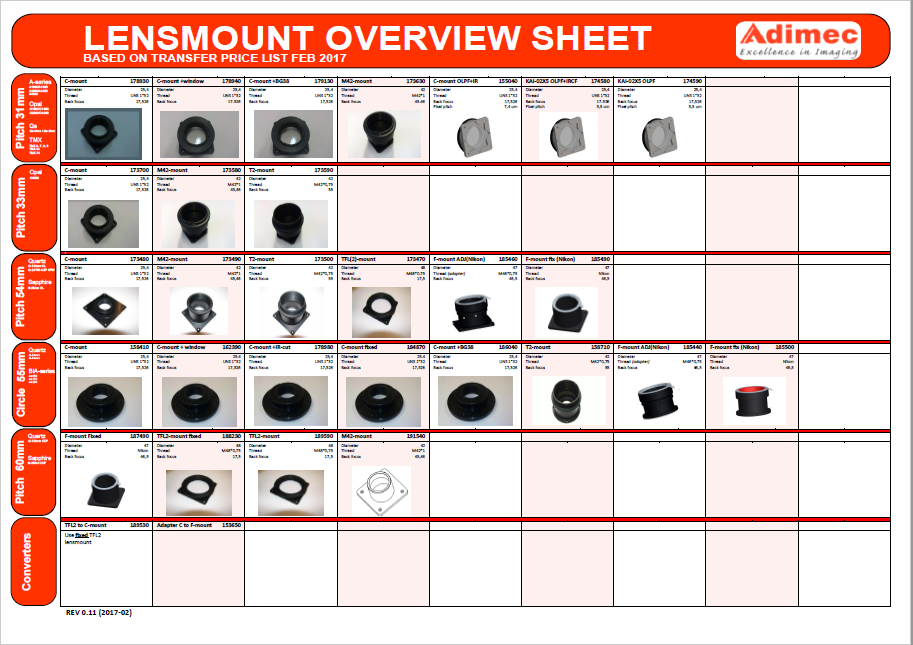
Credit: www.adimec.com
Frequently Asked Questions
What Is The Difference Between Ef And Ef-s Mounts?
EF is for full-frame cameras, while EF-S fits only Canon APS-C cameras. EF-S lenses won’t fit full-frame bodies.
Can I Use Old Nikon F-mount Lenses On New Nikon Cameras?
Yes, but electronic features like autofocus may not work unless the lens is updated.
Are Lens Adapters Reliable?
Adapters can help, but autofocus speed and image quality may drop. Always check compatibility.
Why Are Mirrorless Mounts Like E-mount And L-mount Growing In Popularity?
Mirrorless mounts are designed for smaller, lighter cameras and offer more advanced features.
Is Micro Four Thirds Good For Beginners?
Yes. Micro Four Thirds cameras are compact and affordable, with plenty of lens choices from different brands.
Choosing the right lens mount type is essential for building your camera system. It impacts every photo you take and determines how easily you can upgrade or experiment. For more technical details, visit the Lens Mount Wikipedia page. Knowing your mount type saves money and helps you grow as a photographer.