Buy it if you shoot video on a Nikon Z9, Z8 or Z6III and you want one lens that covers a whole working day without a bag of primes. This review of the Nikkor 28-135mm covers who should skip it, and that means anyone whose camera isn’t on that list, because the power zoom rocker is the headline feature and the listing ties it to those three bodies. Skip it too if you shoot mostly stills, since the constant f/4 maximum aperture and the video-first controls are aimed at moving pictures.
The Nikon NIKKOR Z 28-135mm f/4 PZ is a full-frame zoom lens for Nikon Z series mirrorless cameras, built around video work rather than stills. Its listing leads with three things: a rocker-style power zoom with 11 speed options, a constant f/4 maximum aperture, and an internal zoom mechanism that keeps the lens the same physical length as you zoom.
That last point matters more than it sounds. A lens that doesn’t grow when you zoom keeps its balance on a gimbal, a drone or a robotic head, and Nikon puts the maximum shift in the center of gravity at about 2mm across the range. For anyone who has re-balanced a rig mid-shoot, that’s the number worth reading twice.
The buyer here is a video shooter who works alone or in a small crew, moves between wide establishing shots and tight closeups in the same take, and wants to do it from behind the camera rather than at the lens barrel. The trade-off is the one this review keeps coming back to: the power zoom’s fastest, most convenient behaviour depends on which camera body you mount it to, and the listing names three. If yours isn’t one of them, you’re paying for a feature set you can’t fully use.
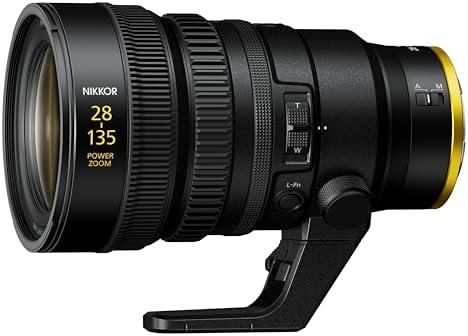
Table of Contents
Who should buy this zoom, and who shouldn’t
Three kinds of buyer fit this lens well, and each one lines up with a specific line in the listing.
The first is the solo video shooter who works on a gimbal. The internal zoom mechanism keeps the physical length of the lens constant while zooming, and Nikon puts the maximum center of gravity shift at about 2mm between 28mm and 135mm. If you’ve ever had a balanced gimbal drift because the lens grew, this is the feature that answers it. You set the rig once and shoot the whole sequence.
The second is the run-and-gun shooter who needs a fast punch-in without touching the barrel. The rocker-style zoom control is customizable, and the listing gives 11 speed options, so you can dial a slow creep for a reveal or a quick snap to a face. The listing says this is supported by the Z9, Z8 and Z6III. If you own one of those, the control works from the camera; if you don’t, the feature is there but the support isn’t.
The third is the shooter who pulls focus by hand and wants repeatable results. Linear focus lets you set the exact rotation of the focus or control ring, so a given turn of the ring always moves focus the same distance. The focus ring is large and textured, and both the focus and zoom rings are knurled, which Nikon says makes them directly compatible with follow-focus accessories. If you already own a follow-focus rig, that’s a direct fit rather than an adapter problem.
Two buyers should leave it alone.
The first is anyone shooting on a Z body outside the three the listing names. The power zoom’s camera-side support is the reason to choose this lens over a plain zoom, and without it you’re carrying the weight of a feature you can’t drive. Look for a standard zoom with a manual zoom ring instead.
The second is the stills-first photographer. A constant f/4 maximum aperture is a working aperture for video, where you rarely want to change exposure mid-shot. If you shoot portraits or events and want shallow depth of field, a faster prime or a wider-aperture zoom serves you better. This lens is built for the shot that keeps moving.
What the NIKKOR Z 28-135mm f/4 PZ actually gives you
Four jobs, and every listed feature belongs to one of them.
Zooming without moving your hands off the rig
The rocker-style zoom control is the centre of this lens. It’s customizable, and Nikon gives 11 speed options, so the same rocker can deliver a slow, even creep for a mood shot or a hard punch-in for a reaction. You keep both hands where they are, which matters when one hand is on a gimbal handle and the other is on a follow-focus wheel.
The condition is the one the listing states plainly: this is supported by the Z9, Z8 and Z6III cameras. Those are the bodies where the camera-side control talks to the lens. On any other Z body, the lens still zooms, but the electronic rocker behaviour the listing describes isn’t something you can count on.
The internal zoom mechanism is the second half of this job. Because the lens doesn’t extend as you zoom, the physical length stays constant, and Nikon puts the maximum center of gravity shift at approximately 2mm across the full 28mm to 135mm range. On a gimbal, a drone or a robotic head, that’s the difference between a rig you balance once and a rig you chase all day.
Together, those two features answer the same question: how do you change framing mid-shot without wrecking the shot? The rocker answers it for your hands, the internal zoom answers it for the rig.
Holding exposure steady while the framing changes
A constant maximum aperture of f/4 across the zoom range means the exposure doesn’t shift as you zoom in or out. On a variable-aperture zoom, pushing in from wide to tight narrows the aperture, and you either accept a darker frame or ride the iris, which is a visible change on screen.
The listing also gives a minimum focus distance of 0.34m, and notes that this is achieved between 28mm and 50mm. That’s the closeup end of the range, and it’s where you get the cinematic blurred background the listing describes. The condition is worth reading carefully: at the longer end of the zoom, you can’t get as close. If your shot needs a tight closeup, you shoot it at the wide end and move the camera, not the zoom ring.
For interview work, product shots and any setup where the camera is locked off and the subject moves, a fixed f/4 keeps the frame consistent take after take. You set exposure once and it holds through the whole zoom range.
Focusing fast when the shot won’t wait
The STM autofocus motor is what Nikon calls fast and reliable, and the listing frames it for the moments when speed and convenience are what matter. That’s documentary work, events, and anything where the subject decides when the moment happens.
For the shots you’d rather control yourself, linear focus lets you set the exact rotation of the focus or control ring. That turns a focus pull into a repeatable movement: the same turn of the ring moves focus the same distance every time, which is what makes a mark on the ring mean something. The large, textured focus ring gives you something to grip, and Nikon describes it as ergonomically textured for precise manual adjustment.
The knurled focus and zoom rings are directly compatible with follow-focus accessories, so a motorized follow-focus clamps onto the ring rather than needing a gear ring added. If you already run a follow-focus setup, that’s one less part in the bag.
The full list of listed specifications
Everything above comes from the same set of listing lines, and the table below collects them in one place so you can check any figure against the source.
| # | What Amazon lists |
|---|---|
| 1 | One touch zoom. Switch from a sweeping establishing shot to a powerful closeup in a snap with a customizable rocker-style zoom control. Quick punch-in or smooth, slow zoom—with 11 speed options. (Supported by Z9, Z8 and Z6III cameras) |
| 2 | Constant maximum aperture. Maximum aperture of f/4 and minimum focus distance of 0.34m (Minimum focus distance of 0.34m is achieved between 28–50mm) allows for dynamic closeups with cinematic blurred backgrounds. |
| 3 | Balanced design. The internal zoom mechanism ensures that the physical length of the lens stays constant during zooming, with only a tiny change to the center of gravity (Maximum center of gravity shift between 28mm and 135mm is approx. 2mm)—essential for mounting on gimbals, drones and robotic heads. |
| 4 | Autofocus you can trust. When speed and convenience are key, the STM autofocus motor provides fast, reliable |
| 5 | Precise focus pulling. Support for linear focus allows you to dial in the exact desired rotation of the focus or control ring for absolute precision; while the large, ergonomically-textured focus ring makes precise manual focus adjustment easy. Knurled focus and zoom rings are directly compatible with follow-focus accessories. |
Nikon NIKKOR Z 28-135mm f/4 PZ: pros and cons
Pros
- Rocker zoom with 11 listed speed options
- Internal zoom holds length and balance steady
- Constant f/4 maximum aperture across the range
- Linear focus gives repeatable manual pulls
- Knurled rings fit follow-focus accessories directly
Cons
- Power zoom support limited to Z9, Z8 and Z6III
- Minimum focus distance of 0.34m only between 28–50mm
Is the NIKKOR Z 28-135mm f/4 PZ worth buying?
Buy it if you shoot video on a Z9, Z8 or Z6III and you want one lens that handles the whole range of a scene without a lens change. Skip it if you shoot on any other Z body, or if your work is stills-first.
For the gimbal shooter, the case is strong. The internal zoom keeps the physical length constant, and Nikon’s figure of roughly 2mm of center of gravity shift across the range means the rig you balance at the start of the day is still balanced at the end. Add the full range of zoom speeds and you can go from a wide establishing shot to a tight closeup without a second operator and without a cut. That’s a real production advantage, not a spec-sheet one.
For the follow-focus operator, the answer is also yes. Linear focus makes a pull repeatable, and the knurled rings take a follow-focus clamp directly, so the gear you already own works with the lens you’re considering.
The trade-off to weigh is narrower than the overview made it sound. This isn’t a question of whether the lens is good at its job; it’s a question of whether your camera can drive it. The power zoom is the reason to pick this lens over a plain zoom, and the listing ties that support to three bodies. If you’re on one of them, the feature earns its place. If you’re not, you’re carrying the weight and the controls of a feature you can’t fully use, and a standard zoom with a manual zoom ring does the same job for your setup. Check your body first, then decide.
Frequently Asked Questions
Does the power zoom work on every Nikon Z camera?
No. The listing states the rocker-style zoom control is supported by the Z9, Z8 and Z6III. On other Z series bodies, the lens still mounts and zooms, but the electronic rocker behaviour isn’t something you can count on.
What do I need to buy separately to use this lens?
What the listing does make clear is that the knurled focus and zoom rings are directly compatible with follow-focus accessories, which means a follow-focus motor clamps onto the ring itself. If you already run that gear, you don’t need an add-on gear ring. If you don’t own one, the lens works without it.
Is a power zoom lens worth owning, or is it a gimmick?
It’s worth owning if you shoot video that changes framing mid-shot. The 11 speed options let you pick a slow creep or a fast punch-in, and the internal zoom keeps the lens the same physical length so a gimbal stays balanced. If your shots are locked off, a manual zoom ring does the same job.
Can I use this lens for stills photography?
Yes, it mounts and focuses like any Z lens, and the constant f/4 maximum aperture and the 0.34m minimum focus distance between 28–50mm both apply to stills. But the design leans toward video: the rocker zoom, the linear focus ring and the internal zoom mechanism are all aimed at moving pictures. If you shoot mostly stills and want shallow depth of field, a faster lens serves you better.
How close can I get to a subject with this lens?
The listing gives a minimum focus distance of 0.34m, achieved between 28mm and 50mm. That’s the wide half of the zoom range. At longer focal lengths you can’t get as close, so plan your closeups around the wide end.
Does the lens need any regular maintenance?
Not according to the listing, which doesn’t mention a service interval, a filter, or any consumable part. The moving element is internal, so the physical length stays constant as you zoom and nothing extends to be knocked. Keep the front element and the mount clean and there’s nothing else the listing asks of you.