Tamron’s 35-150mm F/2-2.8 Di III VXD is a zoom lens for Sony E-mount cameras, and it’s bought for one job: covering a huge zoom range without swapping lenses. The listing leads with three claims. First, Tamron calls it the world’s first zoom with an F2-2.8 fast aperture. Second, it promises outstanding optical performance through the whole range. Third, it points to a fast, quiet VXD linear motor that drives high-speed, high-precision autofocus. Add a 6-year limited USA warranty, and you can see who Tamron built this for.
This is a lens for someone who shoots a lot — event photographers, portrait shooters, travel shooters who don’t want a bag full of primes. You’d carry it on a full-frame Sony body, or an APS-C one, and use it for everything from a wide environmental shot to a tight headshot in the same session. The trade-off is right there in the listing: it’s 6.2 inches long and weighs 41.1 oz, so one lens doing the work of several is heavy in your hand and on your camera strap. Whether that weight is worth it is the question the rest of this review settles.
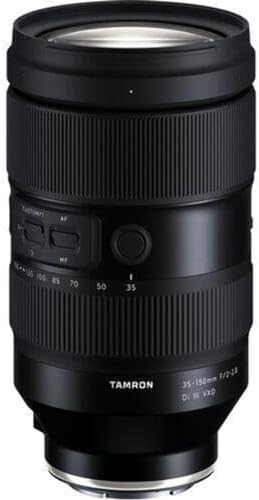
Table of Contents
Who should buy this zoom lens
The clearest match is the event or wedding photographer who works in dim rooms and can’t stop to change lenses. A dance floor, a ceremony, a reception speech — the light is bad, the moments are fast, and a lens swap is a missed shot. An F2 aperture at the wide end and F2.8 throughout the rest of the range means the lens gathers a lot of light at every focal length, which is exactly what that kind of work asks for. The 35-150mm range covers group shots at one end and tight candids at the other, so the listing’s zoom range maps directly onto the job.
Speed matters in that setting too, not just aperture. The VXD linear motor is built for high-speed, high-precision autofocus, so the lens can keep up with people moving toward you across a room. Quiet focusing helps as well; nobody wants a whirring lens audible during vows or a toast.
The second match is the portrait photographer who wants to shoot an entire session without swapping glass. At the long end, framing is tight and backgrounds fall away; at the wide end you can step back for a full-body shot with surroundings. The close-focusing figure matters here too — Tamron lists a minimum object distance of 13 inches at the wide end, so you can move in for detail shots of rings, hands, flowers or food without carrying a separate macro-style lens.
It also suits the Sony owner who already has a full-frame or APS-C body and wants a single zoom to cover most of what they shoot. The listed warranty is worth noting for that buyer: six years, limited, in the USA. That is a long coverage window for a lens you will be working hard, and it softens the risk of committing to a single do-everything zoom.
Who should skip it? If you shoot mostly from a tripod in a studio, or you rarely go past a normal focal length, a big-range zoom is more lens than your work needs. And if you count every ounce in a travel pack, the listing’s own numbers argue against it: 41.1 oz is a real weight on a small body, all day, and at 6.2 inches long the lens is no pocket-sized companion either. Someone in that position should look for a lighter, shorter-range zoom that matches the focal lengths they actually use, and accept the frequent lens changes that come with a narrower kit.
What you get from this lens
The Tamron 35-150mm F/2-2.8 Di III VXD gives its owner three things at once: a zoom range that replaces several lenses, a fast aperture that holds up in poor light, and an autofocus system built for moving subjects. Here’s how those break down in daily use.
One lens for wide shots and tight ones
The 35-150mm range is the headline. At 35mm you frame a room, a table of guests, or a person in their setting. Twisting to 150mm, you’re isolating a face across that same room. On a full-frame Sony body that’s the span most event, portrait and travel work lives in, and on an APS-C body it behaves like a longer reach, since the smaller sensor crops the view. The practical change is simple: fewer lens swaps mid-shoot, and fewer moments lost while you dig through a bag. The listing doesn’t state whether the lens is weather-sealed, so if you shoot outdoors in rain or dust, check that with Tamron before you buy.
The F2-2.8 aperture and what it changes
Tamron leads with the claim that this is the world’s first F2-2.8 fast aperture zoom, and the number that matters is what that aperture does at the long end. Most zooms slow down as you zoom in; this one holds F2.8 across the whole range and opens to F2 at 35mm. In a dim venue, that’s the difference between a usable shutter speed and a blurred frame, because the aperture lets in more light at every focal length. It also narrows depth of field, which is what separates a subject from its background in a portrait.
That speed shows in the size. The listing puts the lens at 6.2 inches long and 41.1 oz — over two and a half pounds. If you’ve been carrying a kit of small primes, this replaces them with a single heavier body-lens combination, and your shoulder will notice over a full event day. The trade is deliberate: the fast aperture and the wide zoom range are a big reason for the size.
Autofocus built for moving subjects
The VXD linear motor is Tamron’s stated answer to focus speed, and the listing describes it as fast and quiet, delivering high-speed and high-precision autofocus. For the buyer, that means two things. Fast, precise focus matters when a subject is walking toward you, dancing, or turning their head — the lens has to keep up or the shot is gone. Quiet focus matters when you’re recording video or working close to people; a whirring motor is audible on a clip and noticeable in a quiet room.
Close focusing for detail work
Tamron lists a minimum object distance of 13 inches at the wide end, and calls the close-focusing capability superior. The minimum object distance is how close the front of the lens can get to your subject and still focus. What that changes in practice is what you can shoot without extra gear. At 13 inches from the wide end, you can fill the frame with a ring, a plated dish, or a detail on a dress — the kind of shot that normally means carrying a second, dedicated lens. It also makes the lens more flexible in tight spaces, where stepping back isn’t an option. For an event shooter, that’s one more job the same glass covers.
Tamron backs the lens with a 6-year limited USA warranty, which is a long coverage window and a real signal about how the maker expects it to hold up. The full list of specifications is below.
| # | What Amazon lists |
|---|---|
| 1 | The world’s first F2-2.8 fast aperture zoom lens |
| 2 | Outstanding optical performance throughout the range |
| 3 | Fast, quiet VXD linear motor for high-speed and high-precision autofocus |
| 4 | Superior close-focusing capability with an MOD 13” at the wide end |
| 5 | Lens is 6.2 inches long and weighs 41.1 oz |
Pros and cons at a glance
Pros
- World’s first F2-2.8 aperture zoom, per Tamron
- 35-150mm range covers most shooting situations
- Fast, quiet VXD autofocus motor
- Close focus at 13 inches on the wide end
- 6-year limited USA warranty
Cons
- Weighs 41.1 oz, per the listing
- 6.2 inches long, a large lens to carry
Should you buy the Tamron 35-150mm?
Buy it if you shoot fast, unpredictable events on a Sony E-mount body and you’re tired of swapping lenses. This is the lens Tamron built for that exact person: a 35-150mm range, an aperture that stays fast across the whole zoom, autofocus the maker rates as fast and precise, and a 13-inch close-focus distance for detail shots. The 6-year USA warranty also says the company expects this lens to be worked hard for years, not babbled over on a shelf.
For the event and wedding shooter, the answer is a clear yes. Your rooms are dark, your moments are unrepeatable, and the F2-2.8 aperture plus the wide zoom range remove the two biggest causes of missed frames — bad light and a bag of lenses. Tamron calls this the world’s first F2-2.8 zoom, so there is no direct rival offering the same combination. The VXD linear motor driving the autofocus is built for speed and precision, which matters when a subject is moving toward you down an aisle. The weight is real, but it’s weight you carry instead of a second and third lens, and that’s usually the better trade.
For the casual or travel shooter, think harder. If your camera lives in a drawer between trips, 41.1 oz on a strap is a lot of lens to justify, and a shorter-range zoom would suit you better. It helps to picture the size: 6.2 inches long, hanging from your shoulder all day. The honest test is simple: count how often you actually shoot between 35mm and 150mm in mixed light. If the answer is often, this lens earns its bulk. If it’s rarely, look for something lighter and more specialised instead.
Frequently Asked Questions
Does it work on APS-C Sony cameras, or full frame only?
Both. The listing states the lens is made for Sony E-mount and covers full frame and APS-C sensors, so it mounts and works on either. On APS-C the camera crops the image, narrowing your field of view — you lose the full-frame wide view but gain extra reach at the long end. Check your camera’s mount is Sony E before ordering.
What’s included in the box, and do I need to buy anything else?
The listing doesn’t spell out the box contents, so check the product page or ask the seller if you need a specific accessory. What it does confirm is the warranty: limited coverage from Tamron in the USA over a notably long window. Beyond that, all you need is a Sony E-mount body.
How do I care for a lens like this?
Treat it like the precision instrument it is. Keep the front element covered, use a blower before any cloth touches the glass, and store it dry. The listing doesn’t state whether the lens is weather-sealed, so don’t assume it shrugs off rain or dust — check with Tamron directly. Read the limited USA warranty’s terms on Tamron’s site.
Is a big zoom lens like this really worth owning?
For the right shooter, yes. One lens covering 35mm to 150mm replaces the several primes or shorter zooms that span the same ground, and the F2-2.8 aperture means you’re not giving up light to get that range. If you regularly work dark rooms and changing distances, one lens that does everything beats three that each do less.
How close can I really get with this lens?
Tamron lists a minimum object distance of 13 inches, measured at the wide end of the zoom. At 35mm you can position the lens about 13 inches from your subject and still focus — close enough to fill the frame with a plated dish or a detail on clothing. As you zoom toward 150mm, that minimum distance grows.